
Welcome to the first blog of this year. Hitting the ground running this year thus far has kept me so engaged with setting up our online training courses that I am only now getting to our first blog. Keep an eye on this blog space…soon all that juicy fresh online piercing training course will be announced.
For today, I thought for us to discuss Piercing Gauges.
The history of the gauge is surprisingly long and complex, though an appreciation of it is the best way to understand why the scale appears so counterintuitive from a modern scientific perspective. Gauge sizes work in reverse, meaning that higher numbers (like 16 gauges) are thinner than smaller numbers (like a 6 gauge). This smaller-is-bigger and bigger-is-smaller rule of thumb is counterintuitive, so you’ll have to actively remember that fact.
In our piercing world, the word gauge (pronounced GAYj) is used to refer to the thickness of body jewelry, and how wide the shaft of a post is rather than how long it is. It refers to how big of a piercing tunnel is needed to accommodate the jewelry.
Here is how gauges compare to diameters in millimeters:
- 18 gauge = 1.0 millimeters (Ear, Nostril piercings)
- 16 gauge = 1.29 millimeters
- 14 gauge = 1.6 millimeters (Tongue, Navel, Labret, Nipple, Septum piercings)
- 10 gauge = 2.59 millimeters
- 8 gauge = 3.2 millimeters
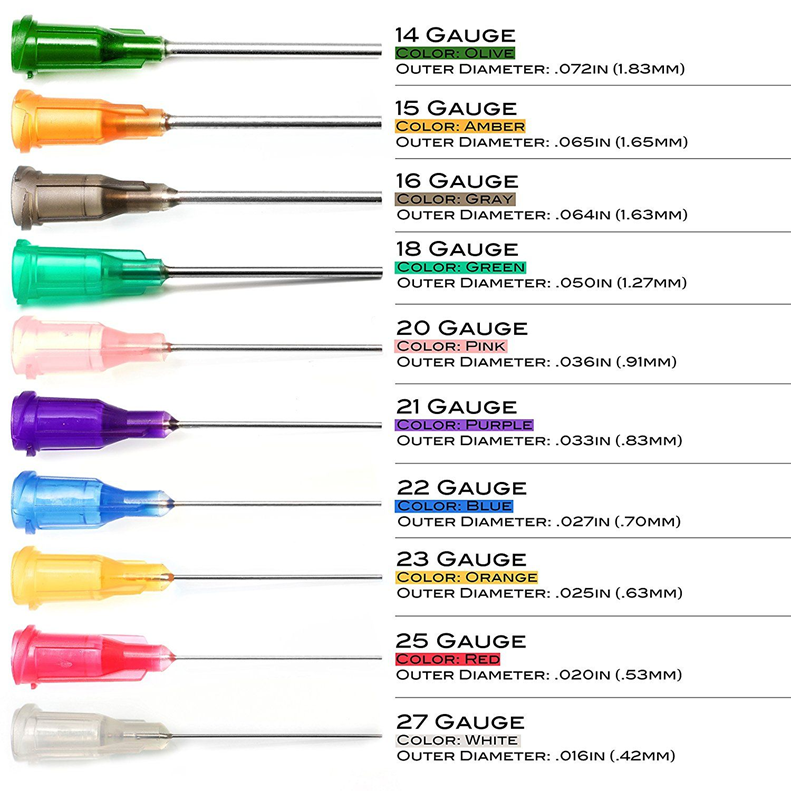
The gauge size of a needle indicates what the diameter of the lumen (opening) is. The higher the gauge, the smaller the diameter. For example, a 30-gauge needle has a narrower lumen than a 25-gauge needle. Different companies use different measurements for gauges, so it is important to specify the inner diameter.
Understanding the history and purpose of piercing gauges can help you navigate the sometimes confusing world of body jewelry and piercings. Remember, when it comes to gauges, smaller numbers mean thicker jewelry, and larger numbers mean thinner jewelry.
Ps, At the bottom, if you want to be removed from this mailing list please click the unsubscribe button and we will no longer send you any further communication. BUT, if you are enjoying being part of this mailing list, please pass along our links to your friends for them to also subscribe!
Best Regards – Jax