
- Piercing Bumps:
Granulomas, Hypertrophic Scarring and Keloids
1.1 Identification:
1.1.1 A piercing bump is generally a raised bump that typically just grows right above the piercing site. Piercing bumps in most cases are more than likely, Granulomas. Formation of granulomas is often caused by an infection. During an infection, immune cells surround and isolate foreign material, or bacteria. The fistula (tunnel in through the skin that jewellery sits in) heals from the outside inward and the body will try and expel that irritant and make an infection spot at the ends or opening of the fistula to release the pressure of the building up of liquids. Granulomas can also be caused by the immune system or inflammatory conditions. If you can see inside that bump, it more than likely is a granuloma. Having the key site too wet will lead to bumps and infections. Sometimes the jewellery is the culprit with metals leeching into the fistula.
1.1.2 The bleeding bumpy lesions commonly found on earlobes; suggest a diagnosis of Pyogenic Granuloma (PG). PG is among the common skin lesions and is believed to occur due to a reactive increase of capillary blood vessels. Some degree of discomfort and repeated mild bleeding is a hallmark of PG.
Granuloma
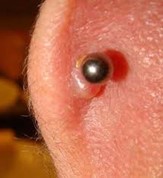
Pyogenic Granuloma
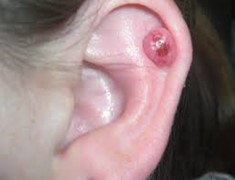
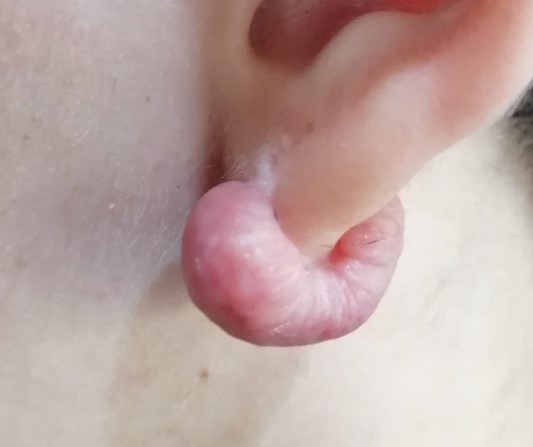
1.1.3 Keloids look more like scars and can range from pink to a deep red and is made up of fibrous scar tissue. Hypertrophic scarring is exactly what the name says, made up of connective tissue, called scar tissue. Hypertrophic and keloid scars are two types of raised, abnormal scars. Hypertrophic scars grow within the borders of the original wound and eventually grow smaller, but keloids grow beyond the original wound borders and are the result of excess collagen being produced at the site of a wound. Keloid scars and hypertrophic scars do not grow smaller on their own and are difficult to treat.

Keloids may continue to grow slowly for weeks, months or years. They eventually stop growing but do not disappear on their own. Once a keloid develops, it is permanent unless removed surgically. It is common for keloids that have been removed or treated to return. Keloids can take on bizarre shapes. Unlike more typical scars, keloids can look almost like melted plastic that has solidified. Keloids don’t form when the skin is injured; they form when the skin is healing. They form mostly on places where there is a lot of movement, or a foreign object the body needs to expel, or due to genetics or toxins.
1.2 Treatment:
1.2.1 Small granulomas may go away on their own as the body successfully get rid of whatever was irritating it. It is advised to take a photo and again in a few days’ time. To visually assess the increase or decrease of the actual size of the granuloma. This is best done by taking photos to assist you with the visual assessment. Then start a treatment regime by using heat and pressure with a warm water or camomile compress, once a day for a few days. Re-assess in a few days and if there is no visual improvement, make a small paste of Bicarbonate of Soda and a drop of distilled water. Put this paste into the granuloma and leave over night to then be washed off. Apply this paste only once a day, generally at night also for a few days. It is most important to do visual inspection of the site to ascertain if the granuloma is responding to the course of treatment applied. Granulomas generally react very fast to treatment. If the offensive granuloma/ piercing bump is not reacting to either of above treatments, apply a drop of apple cider vinegar to the granuloma before bed. Repeat for a few days and re-assess the effect of the vinegar. It is to be noted here that fresh piercings generally should not be receiving any acidity while healing. Further note that Apple Cider vinegar can also, not be applied to the skin for prolonged periods, without adverse reaction. Also is not advised with pyogenic granulomas.
All the above mentioned treatments can be replaced with some prescription topical treatments such as Corticosteroid creams.
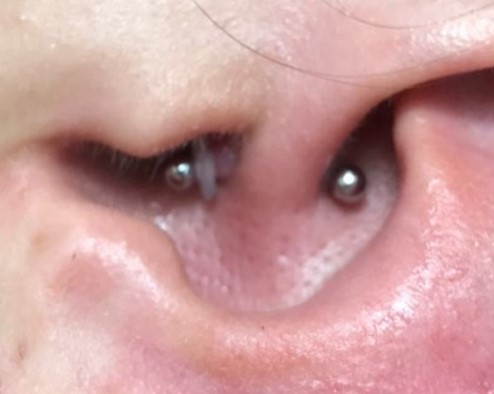
1.2.2 Topical Corticosteroid cream or ointments are advised for the treatment of pyogenic granulomas. These are more serious medical conditions and might need the use of antibiotics.
1.2.3 Healing of hypertrophic scarring is in a mostly about giving it time. As the extra collagen breaks down, the bump goes away on its own. If not, compression treatment can be applied using a PTFE piercing disc, sitting flat on the bump as with persistent granulomas.
1.2.4 Treatment of keloids includes occlusive dressings, compression therapy, intra-lesional corticosteroid injections, cryosurgery, excision, radiation therapy, laser therapy, interferon therapy and other promising, lesser-known therapies directed at collagen synthesis. The treatment and removal of keloids is a very specialized medical subject and do not have a good success rate.
1.2.5 The application of Tea Tree Oil to the skin can cause an allergic reaction. Tea tree oil has caused more allergic reactions than any other form of essential oil. The potential for causing an allergic reaction increases as the oil ages and its chemical composition changes. There’s no evidence to support using tea tree oil on existing scars, whether they’re acne scars, keloids, or hypertrophic scars; to be a successful treatment.
Always Contact your Professional Piercer when you get a piercing bump.